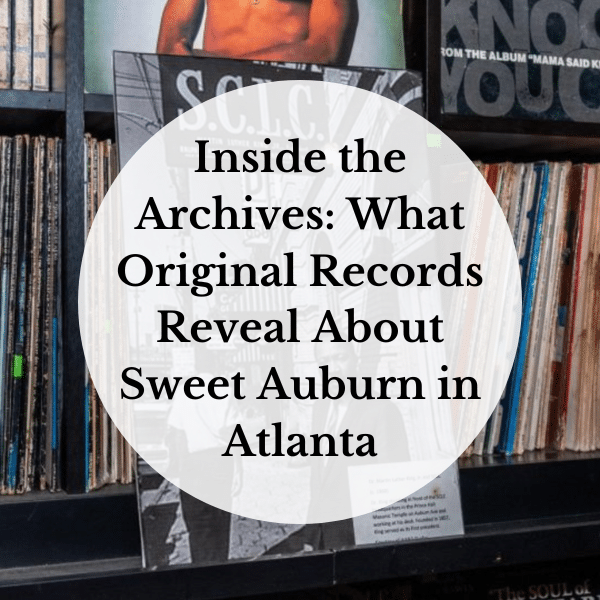
Sweet Auburn has plaques on almost every block. What the plaques leave out is the paperwork underneath them: lease agreements, board minutes, voter registration counts, interview transcripts, and construction plans, most of it held in a public archive at the west end of the district.
Our tours are created by historians, which is why our Atlanta Civil Rights itinerary and our field-trip guide to the King Historic District read the way they do. Akila McConnell, Unexpected Atlanta’s founder and the author of A Culinary History of Atlanta, has spent years in these collections researching the tours we run on Auburn Avenue. Five of the collections that document this neighborhood are open to the public by appointment, and here is what is in them.
What Sweet Auburn Records Are Open to the Public?
Most of them are held a few blocks from the King Historic District. The Auburn Avenue Research Library on African American Culture and History opened in May 1994 as the first public library in the Southeast to offer specialized archival collections for the study of African American history, and it anchors the west end of the historic district. Its Archives Division holds personal papers, organizational records, photographs, oral histories, and ephemera, concentrated on local Atlanta history.
The collections that matter most for this neighborhood:
- Sweet Auburn Neighborhood Project oral history interviews, recorded in 1978 with residents and merchants
- Sweet Auburn Curb (Municipal) Market collection, 18 boxes spanning 1920 to 2013
- John Wesley Dobbs / Prince Hall Masons collection, 2.5 linear feet dating from 1950 to 1968
- Atlanta Life Insurance Company records
- William L. Calloway papers, which include an autographed copy of “The ‘Sweet Auburn Avenue’ Business History, 1900-1988”
The Atlanta Daily World’s own archives sit elsewhere, in the African American collections at Emory University’s Rose Library.
What Do the 1978 Oral Histories Reveal That the Plaques Do Not?
They record what residents remembered, in their own words, about events no marker mentions: the 1906 Atlanta Race Massacre, which the interviewers catalogued in the language of the time as “the riot of 1906,” the 1917 fire, the Depression, the Butler Street Urban Renewal Project of the 1950s, and cross-town migration. The collection runs to 71 audiotapes with transcripts*, and there are no restrictions on research use.
The way the collection was made is its own piece of history. Local teenagers were trained to conduct the interviews, index the subjects, and contribute to the photography, and the same young people researched and wrote a Sweet Auburn walking tour book.
*Prior permission from the Research Library must be obtained in writing before any portion of this collection can be published or reproduced.
Who Named Sweet Auburn and What Did the Name Mean?
John Wesley Dobbs coined it, and he borrowed it from a poem. Dobbs took the phrase from Oliver Goldsmith’s “The Deserted Village.” in which Goldsmith writes:
Sweet Auburn, loveliest village of the plain,
Where health and plenty cheared the labouring swain,
Where smiling spring its earliest visit paid,
And parting summer’s lingering blooms delayed . . . .
Dobbs felt that referring to the neighborhood as Sweet Auburn reflected all of the “health and plenty” that could be found on the “loveliest” street of Auburn Avenue. He focused on three pillars, bucks, ballots, and books, meaning that by combining economic power, voting power, and education, Sweet Auburn and Atlanta’s Black middle class would keep growing. In 1956, Fortune magazine agreed, calling Sweet Auburn the richest street for African Americans in the world.
Dobbs was elected Grand Master of the Prince Hall Masons of Georgia in 1932, earning the nickname “the Grand,” and held the post for the rest of his life. The registration drives he led added 20,000 Black voters in Atlanta over the following decade. That bloc is why Mayor William B. Hartsfield hired the city’s first eight Black police officers in 1948 and installed street lamps on Auburn Avenue the following year.
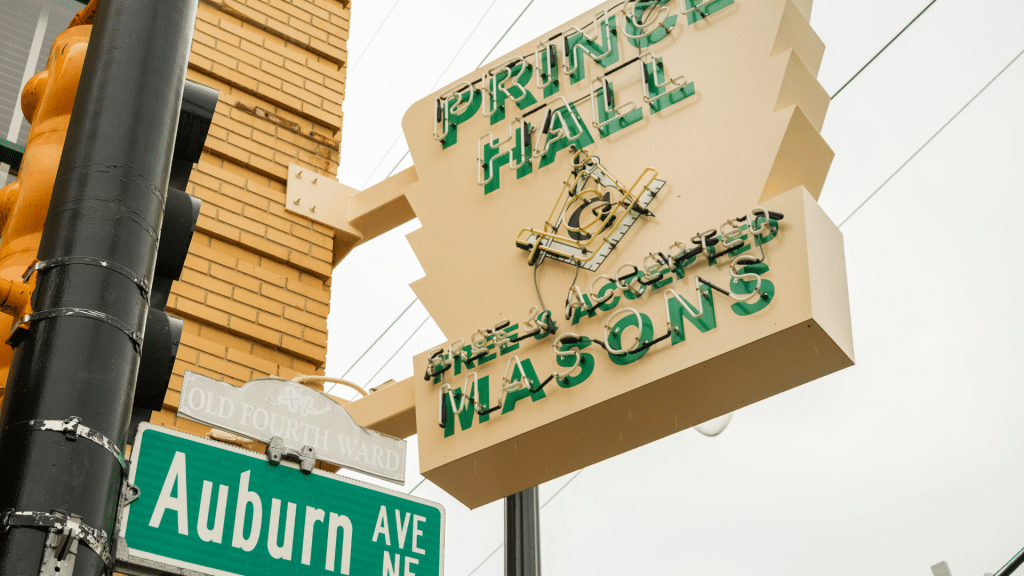
What Happened Inside the Prince Hall Grand Lodge at 334 Auburn Avenue?
Two things at once, on two floors. On October 3, 1949, WERD began broadcasting from the second floor after Jesse B. Blayton Sr. bought the 1,000-watt station for $50,000, making it the first radio station in America owned and operated by African Americans. Blayton was Georgia’s first Black certified public accountant and a bank president.
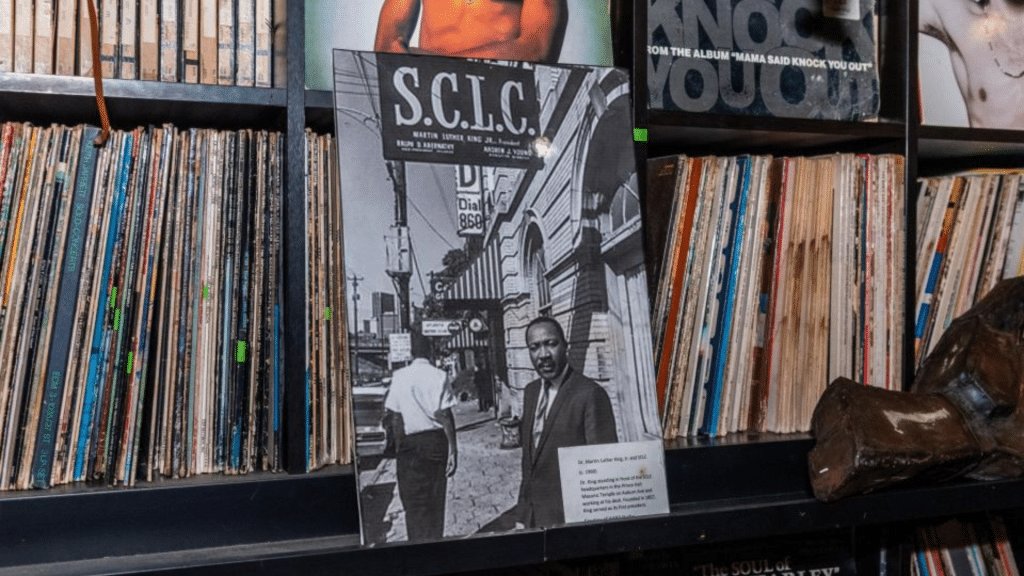
The Southern Christian Leadership Conference, formed in 1957 and led by Dr. King, kept its headquarters one floor below the studio. Announcer Jack Gibson described the arrangement that resulted: King would tap the SCLC office ceiling with a broomstick, and Gibson would lower a microphone out of the studio window to the window below. Blayton sold the station in 1968.
What Do Auburn Avenue’s Business Records Show?
Auburn Avenue’s business records show the history of this remarkable neighborhood. The street ran on Black capital, as documented year by year. Alonzo Herndon bought the Atlanta Benevolent and Protective Association in 1905 and renamed it the Atlanta Life Insurance Company. By the end of 1924 it had expanded into six more states, and its assets grew by nearly a million dollars before Norris Herndon took over at his father’s death on July 21, 1927.
- A. Scott II founded the weekly Atlanta World on August 5, 1928, at age 26. It became a daily in 1932 and one of the first Black daily papers in the country, and its offices stayed on Auburn Avenue until 2008, when the downtown tornado damaged 145 Auburn.
The Curb Market papers are the least glamorous and the most revealing: court records, lease agreements, correspondence, board minutes, audits, budgets, ledger booklets, and construction plans, 1920 through 2013. Ninety-three years of stall leases and board decisions, filed in one place. Our Historic Market Food Tour + Biscuit Class runs inside that building.
Wesley Chapel Redding: An Example of the Stories Found in the Archives
One of the most fascinating stories that Akila’s research uncovered related to the story of Wesley Chapel Redding. Wesley Chapel Redding was born enslaved but his family came to Atlanta when he was a child and he was educated in the city by his mother, who cared deeply about education. As a young man in the 1870s, Redding was hired to work as a receptionist at the legal offices of a judge. Redding was so brilliant that the judge permitted Redding to borrow his legal books and Redding self-educated himself on the state’s laws, acting as a de facto attorney in the Auburn Avenue neighborhood, because Black men were not permitted to get law degrees in Georgia at the time.
And, the young Redding put that legal knowledge to the test. When he was 24 years old, in 1881, the city passed an ordinance banning all Black people from entering public parks. It’s important to note that segregation did not “just happen”, nor was it inevitable; it was an intentional choice that cities took in the 1880s. For sixteen years after the Civil War, Black Atlantans had enjoyed its public parks.
And, two weeks after the ordinance was passed, Redding refused to get up from a city park bench when asked by an officer. The newspaper reported that Redding calmly told the officer, that, quote, “he was there because he had a right to be there and the park was as much for him as anyone.” When the officer arrested him, using his legal knowledge, Redding sued the city for $20,000, about $650,000 today, claiming that the city was violating his constitutional rights. This brave act of civil disobedience was written about in all of the state newspapers.
Unfortunately, we don’t know what happened with the case because the newspapers never reported on the result and the archives do not hold the answer to the case. Here’s what we do know: newspapers believed that Redding would win the case and, by 1891, Redding was a very wealthy man so it’s possible that the city paid Redding a settlement. And, in 1891, using his wealth, Redding co-founded and established the Atlanta Loan and Trust Company, the first Black financial institution in Atlanta. Today, there is a bronze bas relief in the King Historic District honoring Redding.
What Happened to Sweet Auburn After Its Peak?
The Downtown Connector, built through the area in the 1960s, destroyed the street grid east and south of downtown and divided Sweet Auburn in two. The district was designated a National Historic Landmark in 1976, and in 1992 the National Trust for Historic Preservation named it one of America’s 11 Most Endangered Historic Places. The Historic District Development Corporation began rebuilding outward from the houses around Dr. King’s birth home, and the Atlanta Streetcar opened in 2014, running east along Edgewood Avenue and west along Auburn.
How Can You See This Research in Person?
Walk it with a guide. Our Martin Luther King Jr. History Tour covers 1.7 miles in 2.5 hours for $40 per person, connecting Ebenezer Baptist Church, the King Center, and Dr. King’s office at the Prince Hall Grand Lodge. Condé Nast Traveler named it one of the 16 best things to do in Atlanta, and Tripadvisor has called it a Best of the Best experience three years running. Our Atlanta Civil Rights itinerary sequences these sites across a full day. January is the busiest month on Auburn Avenue because of MLK Day, so book early for a weekend date.
Frequently Asked Questions
Where can I see original Sweet Auburn records myself?
At the Auburn Avenue Research Library on African American Culture and History, at the west end of the historic district. Its Archives Division holds the Sweet Auburn Neighborhood Project oral histories, the Curb Market papers, the Dobbs / Prince Hall Masons collection, and the Atlanta Life records. The catalog is searchable online.
Do I need an appointment to use the archives?
Yes. The Archives Division is available by appointment seven days a week and requests 24 hours notice, which you can book at 404-613-4032 or aarl.archives@fultoncountyga.gov. Materials are retrieved by staff and used on site.
Who called Sweet Auburn “the richest Negro street in the world”?
John Wesley Dobbs coined the phrase, and Fortune magazine published it in 1956, in the language of the time. Dobbs also coined the name “Sweet Auburn,” which he took from Oliver Goldsmith’s poem “The Deserted Village.”
Was WERD really the first Black-owned radio station in the United States?
Yes. WERD went on the air from 334 Auburn Avenue on October 3, 1949, after Jesse B. Blayton Sr. purchased it, and it was the first station in the country both owned and operated by African Americans. WDIA in Memphis programmed for a Black audience a year earlier but was white-owned.
How long does it take to walk the Sweet Auburn historic sites?
Our guided route covers 1.7 miles in about 2.5 hours, enough for Ebenezer Baptist Church, the King Center, the birth home block, and the Prince Hall Grand Lodge. On your own, budget a half day if you also want the Curb Market and the research library.
When is the best time to visit Sweet Auburn?
January, if you want the district at its most active, since MLK Day brings programming across the neighborhood and our tours fill fastest that month. For a quieter walk with the same sites, come in February or March.